Allied Pilots Association

Headquartered in Fort Worth, Texas, near Dallas/Fort Worth International Airport, the Allied Pilots Association (APA) serves as the certified collective bargaining agent for the 16,000 professional pilots who fly for American Airlines. APA was founded in 1963 and is the largest independent pilots’ union in the world. APA provides a broad range of representation services for its members and devotes more than 20 percent of its dues income to support aviation safety.


HEADLINES

APA in the News

The Dallas Morning News, Sept. 16


American Airlines pilots union blasts CEO’s leadership

As American Airlines continues to lag Delta and United in earnings, APA President Capt. Nick Silva is wondering whether the carrier needs a new CEO. “The pool of talent to lead airlines seems to be relatively small,” Capt. Silva told The Dallas Morning News. “It’s just the question of, is there somebody out there who can turn the ship around faster?” Read the article …

The Dallas Morning News, Sept. 10


Airline workers remember 9/11 and warn against complacency

“We cannot let time allow us to relax our grip on protecting everyone and protecting our country,” APA spokesperson Capt. Dennis Tajer told The Dallas Morning News. “And I’ll say it bluntly: For those who weren’t born then or were little kids then, do not let my yesterday become your tomorrow.” Read the article …

Forbes, Aug. 17


How Delta Air Lines got a second chance in Texas

APA spokesperson Capt. Dennis Tajer talked to Forbes for an article about Delta Air Lines potentially opening a hub in Austin. He said Delta’s growth at AUS after its retreat from DFW means that “Delta is not in our front yard anymore, but they are certainly in our backyard.” Read the article …

WHAT'S HAPPENING

APA Public Statements

Labor Day

    Labor Day Labor Day marks more than the unofficial end of summer. It is a national recognition of the workers whose skill, sacrifice, and solidarity built this country. Long before Congress established Labor Day in 1894, working people understood that safe working conditions, a fair wage, and dignity on the job are earned, rarely given. The same movement that began in the mines, mills, and foundries reached the aviation industry. Before pilots organized, they faced unsafe working conditions, excessive duty hours, and wages that could be cut at management’s discretion. Early aviation was inherently dangerous, and organized labor helped drive the safety improvements that reduced accident rates by more than 99% over the last century. American Airlines pilots were at the forefront of that effort; in 1939, AA pilots became the first pilot group to achieve 100% membership and negotiate a contract. Organized labor in aviation has never been only about pay. Pilot advocacy produced many of the federal protections, safety standards, and flight time limitations that benefit both pilots and passengers today.  APA was founded on the same principle that American Airlines pilots should have a strong, voice in the decisions that shape our profession, airline, and careers. Since then, American pilots have continued shaping the profession through industry-advancing contracts and safety innovations: reducing monthly hours without reducing pay, integrating flight engineers and pilots into a single seniority, securing job protections, and leading advocacy efforts on ASAP, secondary barriers, pilot qualification standards, ADS-B requirements, and more. This Labor Day, we owe a great debt to the pilots who built this career, Association, and airline. We also honor the workers who championed the labor movement and every member who continues that work through coaching and conversations on the flight deck as well as those working tirelessly on one of our many committees. Our history is not just something to remember. It is something to live up to. Happy Labor Day! CA Nick Silva APA President

APA President Update – May 2026

Last week, I took meetings in New York with four sell-side analysts who cover American Airlines as well as journalists from Bloomberg News. Despite the busy earnings season, these analysts were interested to hear what the pilots of American have to say, and they independently brought up two recurrent themes in our meetings – first, a collective agreement that American is dramatically underperforming its financial potential, and, second, that there is little faith among those who follow our airline and our industry for a living that our management team’s current plan will be able to fully close the financial gap between American and its global network peers. APA was welcomed to these conversations with these industry followers because we are viewed as both credible and professional in how we have chosen to address our concerns about the trajectory of our airline. We have been consistent in our messaging to all audiences, both inside and outside Skyview. Our message has focused on the same three themes for far too long: First, management’s lack of a long-term strategy and its short-term actions are causing our airline to fail to reach the full potential of its assets, network, and people. Second, the current state of the airline is unacceptable. We have seen little in terms of vision, culture change, and operational improvements to believe that meaningful positive progress can be achieved in an acceptable timeframe. And finally, APA is open to any path forward that allows us to work at an airline that values our leadership skills and professionalism, and creates an airline that not only competes but leads the industry and reinstates the pride of working for American Airlines, making our airline the first choice for passengers across the globe. So why did I choose to deliver this message now? Recently, Bloomberg News broke a story about United CEO Scott Kirby’s interest in a merger with our airline. Since that day, the questions and speculation have been abundant: Was Mr. Kirby seriously considering a merger with American? Could such a merger survive regulatory scrutiny? How would Mr. Kirby envision bringing our two airlines together? Four days after the Bloomberg story broke, the AA Corporate Communications and Investor Relations team put out a statement. The proclamation was not from Chairman Greg Smith, CEO Robert Isom, or Chief Strategy Officer Steve Johnson, but it declared that American was not interested in any potential merger with United Airlines. Last Monday, after American had publicly rebuffed his merger idea, Mr. Kirby issued a message to his employees and the public that I encourage you to read. After acknowledging American management’s swift rejection of any merger with United, he proceeded to describe why he believes such a merger would be transformative for both airlines and how it could withstand regulatory scrutiny. He articulated a bold vision for the future of air travel that could be transformative for our passengers, the communities we serve, and, foremost, the very people at American that our C-suite has chosen to disrespect: you. For now, it appears that Mr. Kirby’s vision will remain just an aspiration. However, while he may believe that American’s management has closed the door on him, the boldness of his ideas further underscores how far American has fallen behind our competitors, both domestic and international. As I repeatedly heard in New York last week, American continues to fail to reach its full potential as an airline and a business – or, worse, perhaps we have reached our potential, and this is as good as it gets. Either option is unacceptable for our pilots, and it’s clear that it will take bold ideas and real leadership to restore American to a true place of prominence among global airlines.  What’s next? Of late, AA management has been reaching out to APA more, but the main purpose is to inquire if anyone is trying to “get APA pilots on board with an alternative plan” for the airline. That answer is “Yes.” My phone rings every day with calls from people who are interested in hearing the thoughts and opinions of American’s pilots. However, the calls are not coming from the American Board of Directors or C-suite. It is my hope that all strategic alternatives that could propel our airline forward will receive fulsome reviews from American senior management versus a quick defensive dismissal. We will continue to be a credible resource for anyone who is interested in discussing ideas and hearing the thoughts and opinions of the American pilots – even while the AA Board remains uninterested in engaging with us – and we welcome those discussions. Your professionalism and engagement over the last few months have given APA the influence to speak on your behalf. And based on everything I am hearing, the next few weeks may very well require APA to make some important decisions about what we want the future of American to look like. I look forward to making you a part of that conversation. In Unity, FO Nick Silva APA President

Allied Pilots Association Applauds House Passage of ALERT Act
FOR IMMEDIATE RELEASE CONTACT:  Capt. Dennis Tajer, 847-902-8481/Gregg Overman, 817-312-3901 Allied Pilots Association Applauds House Passage of ALERT Act FORT WORTH, Texas (April 15, 2026) — The Allied Pilots Association (APA), certified collective bargaining agent for the 16,000 pilots of American Airlines, commended the House Transportation & Infrastructure Committee, Chairman Sam Graves, Ranking Member Rick Larsen, and the full House of Representatives for passing the Airspace Location and Enhanced Risk Transparency (ALERT) Act of 2026 with overwhelming bipartisan support. “This strong, bipartisan vote underscores a shared commitment to enhancing aviation safety and strengthening the systems that protect the flying public,” said First Officer Nick Silva, APA President. “We applaud Chairman Graves, Ranking Member Larsen, and members of the Committee and the full House for their leadership and dedication to advancing meaningful safety reforms.” President Silva characterized the ALERT Act as a significant step forward in modernizing aviation safety protocols, improving data sharing, and ensuring that pilots and regulators have the tools necessary to proactively address potential risks. He also emphasized the importance of embracing the precision of ADS-B In technology, which the Rotorcraft Operations Transparency and Oversight Reform (ROTOR) Act mandates. Unlike radar, ADS-B In allows pilots to receive data directly from surrounding aircraft, providing a comprehensive picture of nearby traffic on flight deck displays. “APA remains committed to working with lawmakers and industry stakeholders to ensure that the final legislation enhances aviation safety while supporting the pilots who uphold it every day, and we encourage the House and Senate to come together quickly to produce a final, unified bill incorporating the strongest elements of both ALERT and ROTOR,” President Silva said. “The traveling public and aviation professionals alike depend on a regulatory framework that reflects the highest standards of safety, transparency, and accountability.” Founded in 1963, the Allied Pilots Association – the largest independent pilots union in the United States – is headquartered in Fort Worth, Texas. APA’s membership includes several hundred pilots on full-time military leave of absence serving in the armed forces. The union’s website is AlliedPilots.org.
Rest in Peace to Our Fellow Aviators

Rest in Peace to Our Fellow Aviators Fellow Pilots, Overnight, two Air Canada Jazz pilots tragically lost their lives following a collision with an airport fire rescue vehicle that entered their runway on landing at LGA. Project Wingman is standing by at 817-823-7965 should you need support. These moments are never easy, and APA stands in support of our brothers and sisters over at Air Canada Jazz and ALPA during this difficult time. Rest in peace to our fellow aviators.
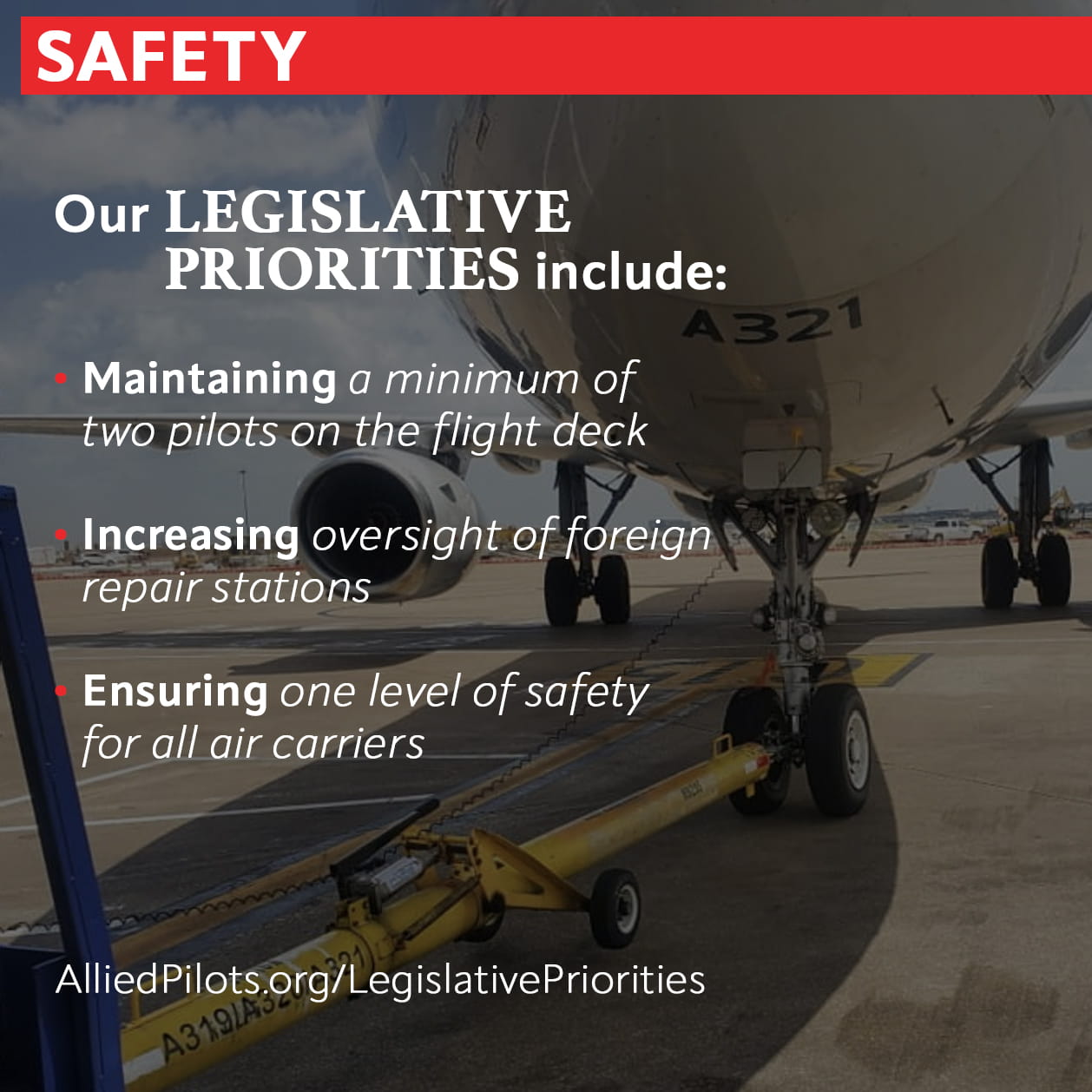
LegislativePriorities_Safety
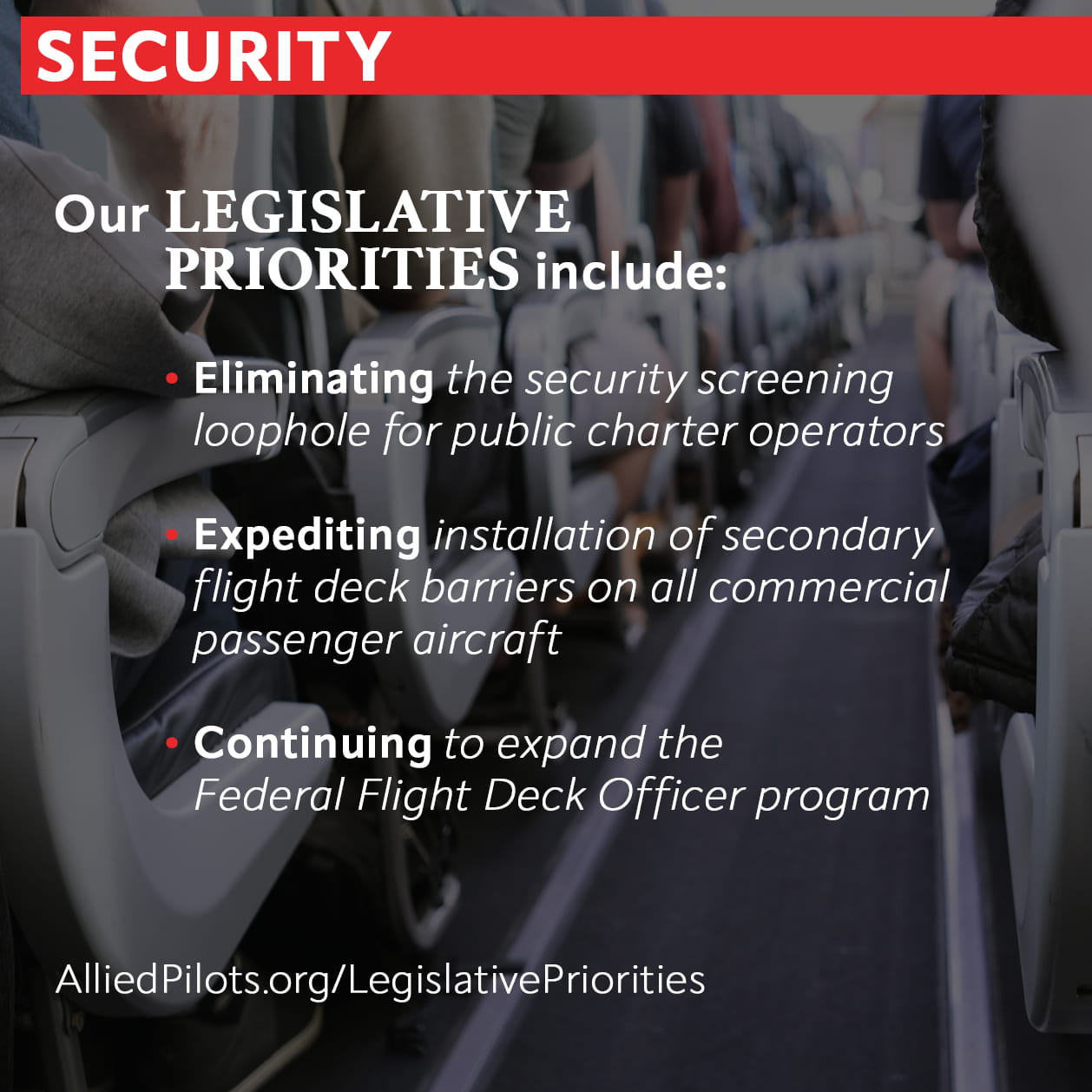
LegislativePriorities_Security
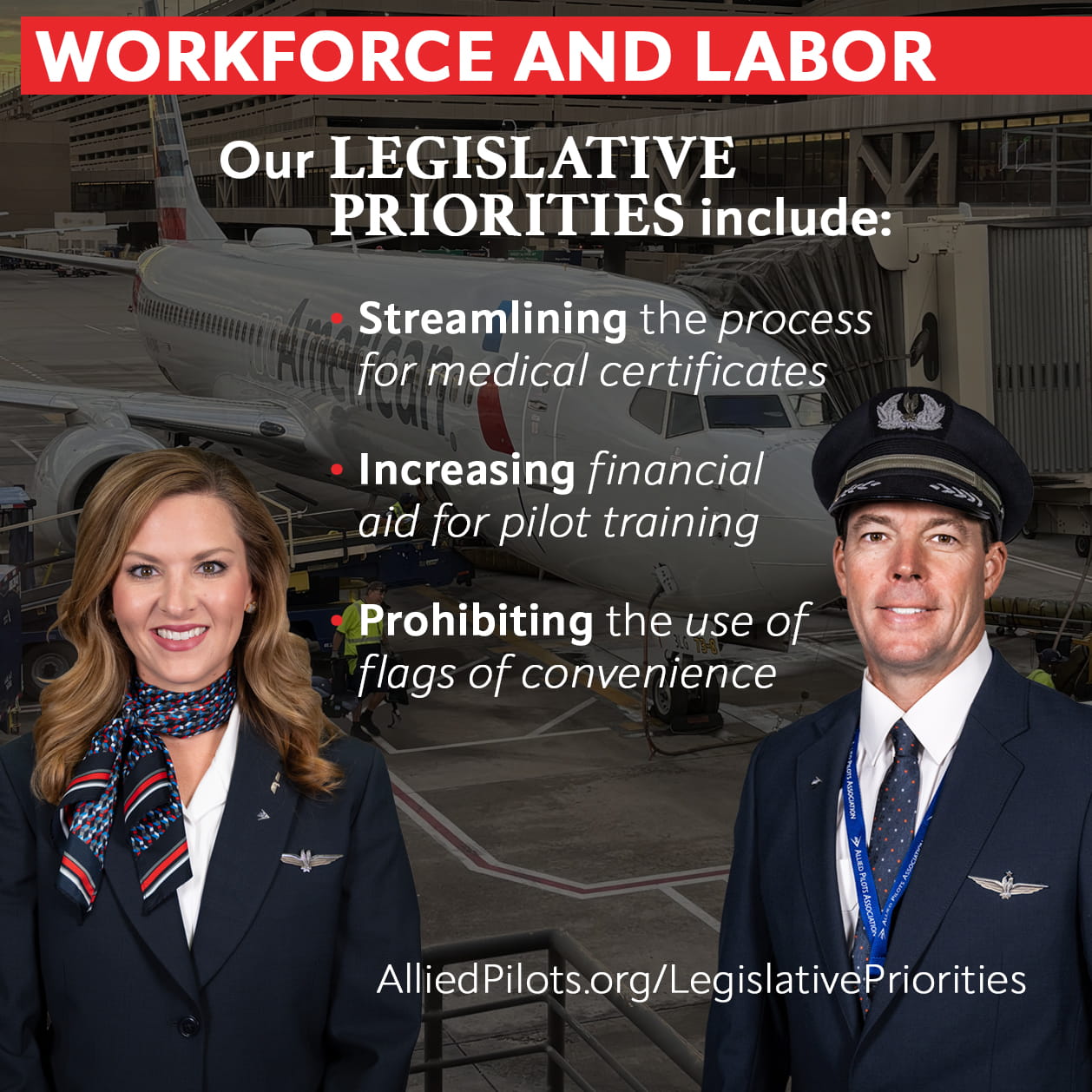
LegislativePriorities_Workforce
task_alt

Toasting